A marketplace where any business designs, sells and redeems its own gift vouchers online — and is paid directly by the buyer, through its own payment account.
Dan Agaba · Founder & Lead Engineer · primarch.work · primarch.admin@gmail.com · +256 780 337 692
01 The idea in one paragraph
A restaurant, salon, supermarket or hotel signs up, draws its own voucher, sets the values it wants to sell, and connects its own payment account.
From then on anyone can buy that voucher from a public shop page, for themselves or for somebody else, and pay by card or mobile money. The recipient gets the voucher by email as a PDF with their name, the value, an expiry date, a unique code and a QR code. At the counter it is checked once and it is spent.
The platform is built and running at vouchers.primarch.work. The screens in this note are the working system, not mock-ups.
02 The problem
A business that wants to sell gift vouchers today has three poor options.
Paper vouchers. Printed in advance, sold only at the counter, easy to photocopy, and tracked in an exercise book. Nobody can say for certain whether one has already been used.
A website of its own. It costs money to build, and the business still has to connect a payment provider and work out how to stop a voucher being spent twice.
A marketplace that collects the money. The business waits for a payout, pays a commission on every sale, and its customers’ money sits with a third party in the meantime.
The buyer has a difficulty of their own. Sending a gift to a relative in another town, or to five members of staff at once, means going to the shop in person — so mostly it is done in cash, or not at all.
03 Who does what
The business
Designs the voucher, sets its values, connects its own payment account, and redeems vouchers at the counter.
The buyer
Picks vouchers in the shop, says who each one is for, checks them, and pays.
The recipient
Receives a named voucher by email and shows it, on a phone or printed, when using it.
The platform
Approves businesses, sets the plans they subscribe to, and decides which payment providers are offered.
The money goes from the buyer to the business. The platform never holds it.
04 How it works, screen by screen
The business designs its voucher
business · step 1
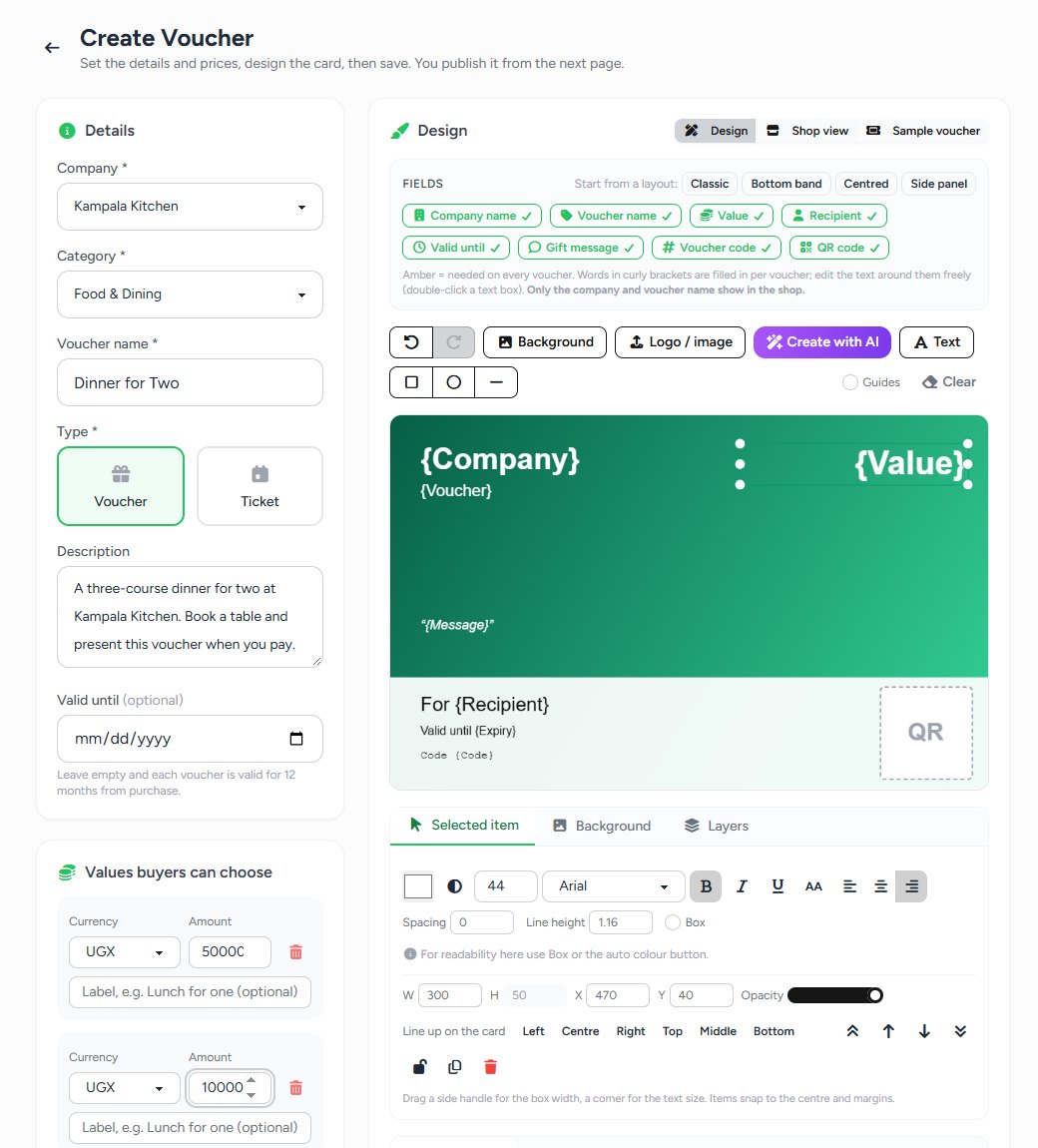
The designer is a card the size of a voucher. The business starts from a ready layout, or from its own artwork, and places the fields where it wants them: its name, the voucher name, the value, the recipient, the expiry date, a gift message, the code and the QR.
It works like a simple design tool — undo and redo, snap-to-centre guides, shapes, background photos that can be darkened or blurred so text stays readable, and a list of layers. No designer needs to be hired.
The designer. Words in curly brackets are filled in separately for every voucher sold. Only the business name and voucher name are shown in the shop; the rest appears once the buyer has said who the voucher is for.
Or lets AI draw it
business · optional
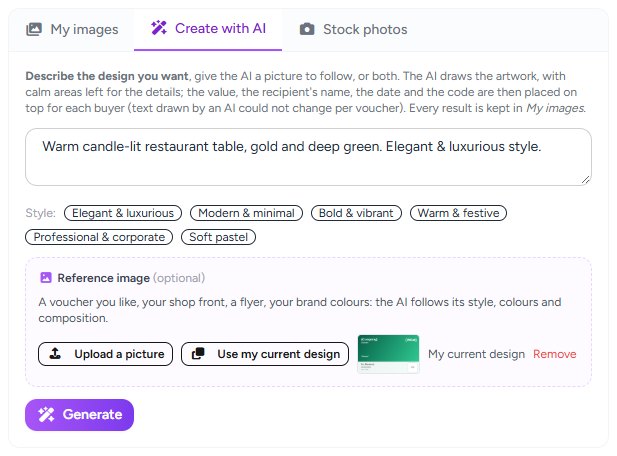
A business with no artwork can describe what it wants in a sentence, or hand the AI a picture to follow — a voucher it likes, its shop front, a flyer — and get background artwork back in under a minute. Stock photos are searchable from the same place.
The AI draws the artwork only. The value, name, date and code are still placed on top by the system for each buyer, because those have to be exact and different on every voucher.
Create with AI: a description, a style, and optionally a reference picture.
The buyer chooses
buyer · step 1
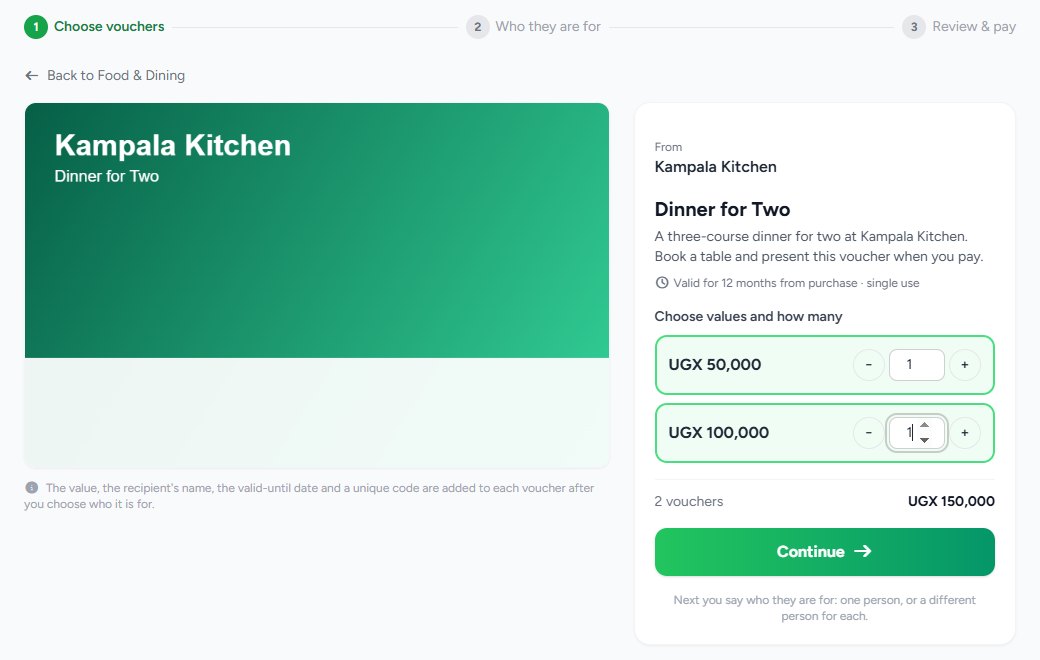
The shop lists only vouchers that can be bought right now. The buyer opens one, and picks the values and how many of each. No account and no sign-in are needed to buy.
A voucher in the shop. One value or several, any quantity.
The buyer says who each voucher is for
buyer · step 2
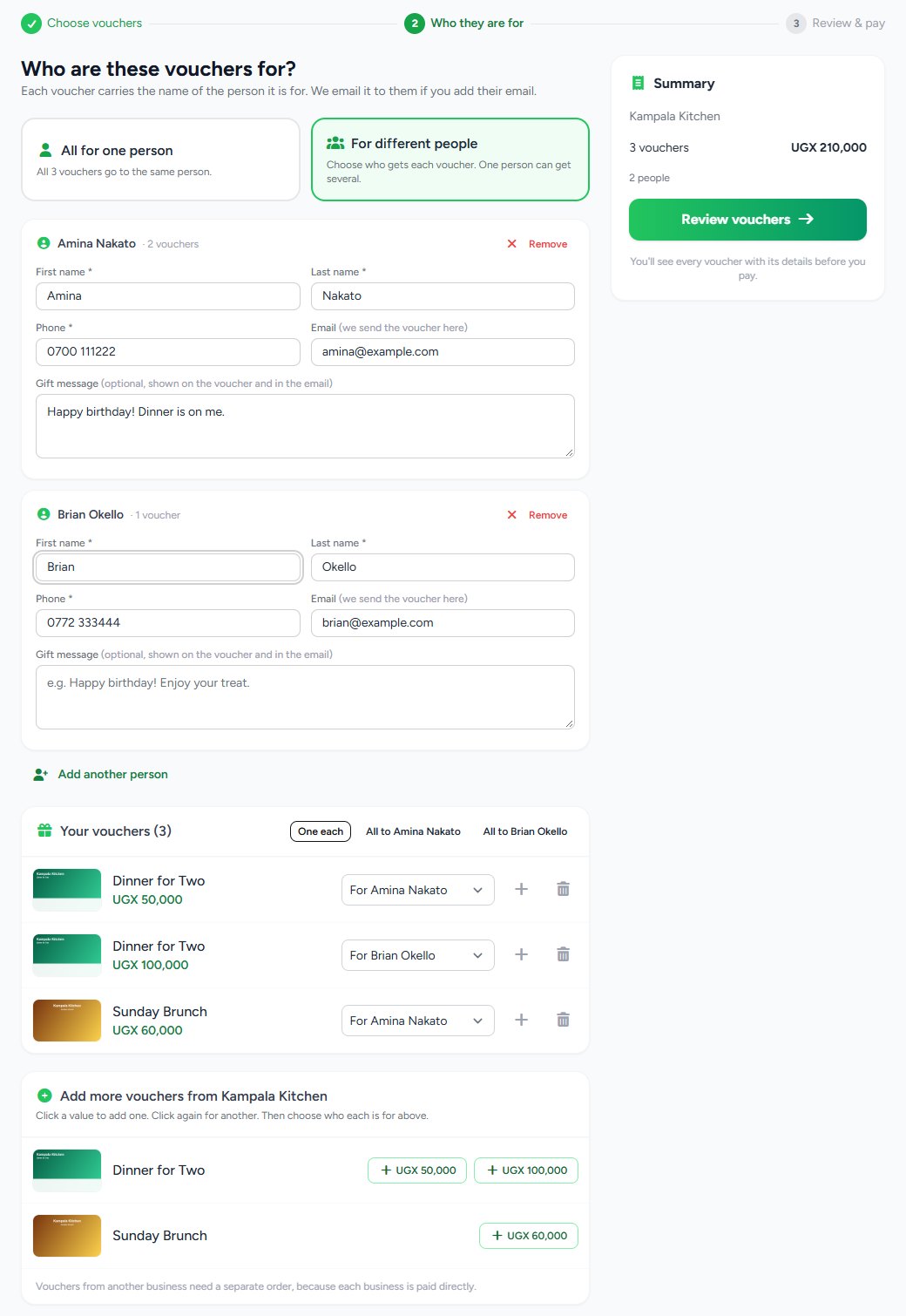
This is the step that paper cannot do. One voucher for one person; several vouchers for one person; or several vouchers for several people — a manager buying for a team, a family buying for relatives. Each person gets their own name on the voucher, their own optional gift message, and their own email.
More vouchers from the same business, of any kind it sells, can be added from this page without starting again.
Three vouchers of two kinds, shared between two people, in one order and one payment.
The buyer checks every voucher, then pays
buyer · step 3
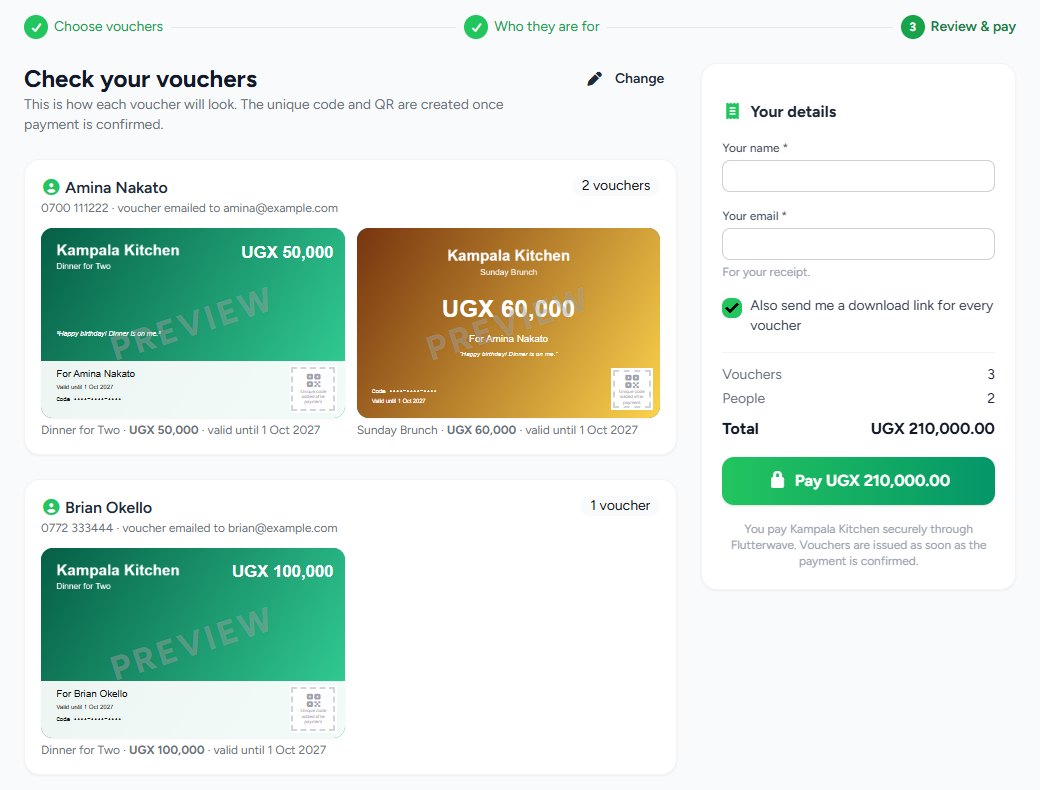
Before paying, the buyer sees each voucher exactly as it will be issued — the right name, value and expiry date on the business’s own design. The unique code and QR are created only once the payment is confirmed with the payment provider, never before.
The review page. What the buyer sees here is what the recipient receives.
The recipient uses it
recipient · counter staff
Each recipient is emailed their voucher as a PDF; the buyer gets a receipt, and download links if they asked for them. At the counter, a member of staff checks the QR or the printed code, sees the value and the name, and marks the voucher as used.
A second use of the same voucher is refused, even if two tills try in the same second. Staff can only check vouchers that belong to their own business.
The checking and redeeming service is built and tested on the server. The screen staff will use at the counter — a phone app that scans the QR — is the next piece to build.
05 Getting paid
Each business is paid through its own account with a payment provider. There is no float held by the platform.
This is usually the first question a finance manager asks, and the answer is the main difference from a marketplace that collects on the seller’s behalf: nothing to reconcile with us, no payout to wait for, no commission taken out of each sale.
Provider
How the buyer pays
State
Flutterwave
Card or mobile money on Flutterwave’s page
Built
Stripe
Card on Stripe’s page
Built
MTN Mobile Money
A prompt on the buyer’s phone, approved with their PIN
Built, not yet run against the live network
Airtel Money
A prompt on the buyer’s phone, approved with their PIN
Built, not yet run against the live network
A business enters test keys first, makes a test payment, and only then switches to live. The platform owner decides which providers are offered, and can add others.
06 Why a voucher cannot be faked or spent twice
Nothing is issued on trust. A voucher exists only after the platform has asked the payment provider directly whether the money arrived, and checked the amount and currency. A buyer returning from the payment page, or a message claiming to be from the provider, is never enough on its own.
Every voucher is unique. It carries its own code and a QR containing a random secret. A photocopy is the same voucher, and only its first use counts.
It is named and dated. The recipient’s name and the valid-until date are printed on it and shown to staff when it is checked.
One use. Redemption is recorded with the time and the member of staff. The business sees every voucher sold, used and outstanding.
07 How the platform earns
From subscriptions paid by businesses, not from a cut of their sales.
A new business, once approved, sells free for a trial period — thirty days as it is set now.
After that it chooses a plan. Plans are created by the platform owner and differ in how many vouchers can be issued a month, how many designs and staff accounts are allowed, and whether AI design and stock photos are included.
The subscription is paid through the same payment providers.
Plan prices are not fixed yet. I would rather set them against what the first few businesses say they would pay than publish a number now.
08 Where it honestly stands
The platform is built and live. It does not yet have paying businesses on it.
Everything described above is finished, deployed on a real server, and covered by an automated test suite. It has a demonstration mode, in which a purchase can be made from start to finish with test money and the vouchers issued are clearly stamped as tests.
For the first businesses that is an advantage. They get direct access to the engineer, pilot terms, and real influence over what is built next.
What is not yet proven
MTN Mobile Money and Airtel Money follow the networks’ published interfaces and pass their tests against simulated replies. They have not yet taken a payment on the live networks.
AI design is built for OpenAI and Google image models and tested the same way; it needs the platform’s own AI account to be connected before businesses can use it.
The counter app that staff will scan vouchers with is not built yet; the redeeming service behind it is.
No business has yet sold a real voucher to a real customer through it.
09 Who it is for
Businesses that would sell
Restaurants, cafés and hotels
Salons, spas and gyms
Supermarkets and retail chains
Bookshops, fashion and furniture stores
People who would buy
Families sending a gift to another town
People abroad buying for relatives at home
Employers rewarding staff, or giving at year end
Companies thanking clients
The corporate buyer is the quieter opportunity. Staff rewards are mostly done in cash or printed paper today; one order here can name twenty people and send each their own voucher.
10 Next step
A live walk-through, screen shared: I design a voucher as a business, you buy it as a customer with test money, and the voucher arrives in your inbox. Twenty minutes is enough.
Three things would make that conversation more useful than a product tour:
Which kind of business would take this first. One restaurant group or one supermarket that says yes is worth more than a list.
What they would pay a month. That sets the plans.
What the real objection will be. Trust, the payment provider they already use, or who answers the phone when a voucher will not scan.